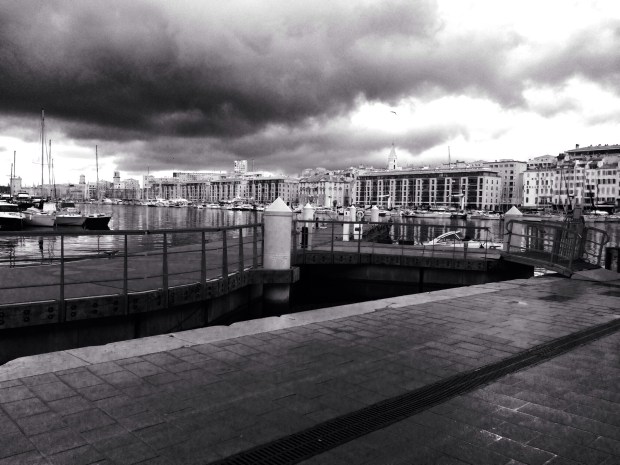
Marseille is one of the most unique cities I’ve ever visited and you notice why the moment you leave the airport. But like most things, you have to know its history to understand it.
It’s about a twenty minute drive into Marseille and you have two options, a cab or the bus to the train station. Either way you take the same main highway down the coast.
You expect the beautiful countryside that is Provence, with its rolling green hills disappearing to the horizon. And you expect the beautiful blue of the Mediterranean as it’s waves roll lazily onto the shore.
But you don’t expect the tenements, the graffiti on every available space or the trash everywhere. As you pull into the train station you start to wonder where exactly you ended up and why you’ve come. And then you hit the center of town and are confronted with something else entirely.
A picture perfect harbor, architecture that looks like it just came off a front cover and water so blue it hurts your eyes. Your mind whiplashes: where are you?
It doesn’t seem like it could be the same place. This is the second largest city in France, a city surrounded by poverty while in the middle of town sits one of the most beautiful scenes in Europe, with incredible food, fantastic bars and some of the freshest seafood you’ll ever find. The more you visit the less sense it makes.
Marseille has been the main area for shipping and heavy transportation in the country for hundreds of years, exporting France’s goods and importing France’s necessities. It was bombed heavily by the Germans during World War II, as was much of the south of France for it’s economic importance. It was then bombed again by the Allies for the same reasons. To say it was simply destroyed is an understatement
After the war the French government needed it’s southern coast rebuilt and needed it done fast. Germany and Italy were paying massive reparations for the war so France had money to burn. This was also the France of 1948, with a massive available workforce willing to work for very little. They did not come from France proper, however, they came from its empire. Specifically from France’s crown jewel, Algeria.
Workers were shipped in by the hundreds of thousands, with a special emphasis on Marseille. It wasn’t long before the city began to regroup from it’s utter devastation and take back a share of its former glory. But this left an interesting predicament.
Spurred on by the stories of a better life in France, millions of immigrants began flooding into Marseilles’ ports. After Algeria gained independence over 150,000 Algerians jumped on ships and moved to Marseille to try and find stability. The French government simply didn’t know how to deal with this massive influx of newcomers who had their own culture and, even more shocking, their own language.
The French language is not simply a language to the French: it IS their culture. I could spend pages upon pages writing about this (the book La Belle France does a fantastic job of explaining this is id you want more) but suffice it to say that unlike America or the Netherlands or really any other western country the French place their language on a pedestal we cannot really comprehend.
So when you have millions of new immigrants who do not speak the corner piece of your nationality, it can only lead to problems. And it has.
Across the country, the two cultures divided, with the French staying in their city centers while the new immigrant classes made homes around the outskirts. The problem continues today.
The grandsons and granddaughters of that massive immigrant influx of the 1950’s have had to live in a country completely unsure of how to integrate them. Not only do many not consider French their main language (although many can speak it fluently) their culture is different as they are predominantly Muslim.
Nowhere is this break more clear than in Marseille, as a majority of the poor are of the immigrant class. For decades this separation had only intensified as Marseilles reasserted itself as the economic powerhouse of southern France. It was an impossible dichotomy of culture and money.
It is getting better: groups like EuroMediterannee have made it their goal to bring the city back to it’s former glory, and since the mid 1990’s have begun to restore huge parts of the city. Seeing pictures of the city from just 15 years before, it’s shocking how much has changed. Every year Ianother new building has been erected, or another old building has been restored.
That restoration, however, has been focused on the city center and you see very little of it outside of there. But it helps to explain how a city can look so different from the outsides versus the in.
This is the story as it was told to me by the people I met while visiting, and it was mentioned again and again as I asked about their city. There is, then, an awareness to the problems Marseille faces even if solutions have not yet presented themselves.
It was with all of this in mind that I went to Marseille for my second time.
 Life Of A Brian
One comment